Wednesday, July 18, 2018
Under The Plum Blossom Tree - A CraftStash Affiliate
Hello Friends! Another quick update for you regarding my affiliate program. Under The Plum Blossom Tree blog has been invited to team up with CraftStash, the UK's No. 1 papercraft store and favourite source for craft supplies and inspiration. As a scrapbooker, I am impressed with the selection of name brands that CraftStash carries. CraftStash stocks many brands that I have personally come to know and love over the years such as American Crafts, Echo Park, and We R Memory Keepers.
What this association means is that you will see the official CraftStash advertising banner on the sidebar or within certain posts in this blog. If you click on the link and make a purchase I may earn a commission.
To more fully understand what affiliate links are and how they work, please visit https://paidforadvertising.com/. Also, by law I am required to have a Disclosure Policy which is now posted at the top menu bar of this blog. You will also see my disclosure policy on any blog posts I may write that promote CraftStash products.
Thank you for supporting Under The Plum Blossom Tree!
Sunday, July 15, 2018
Styling A Vintage Hutch: Antique Chinoiserie Revival Dish ware
Hi Friends! As I was browsing through my favorite charity shop two summers ago a box of antique dishes caught my eye. I thought they looked very interesting but I had no idea what they were so I didn't purchase them.
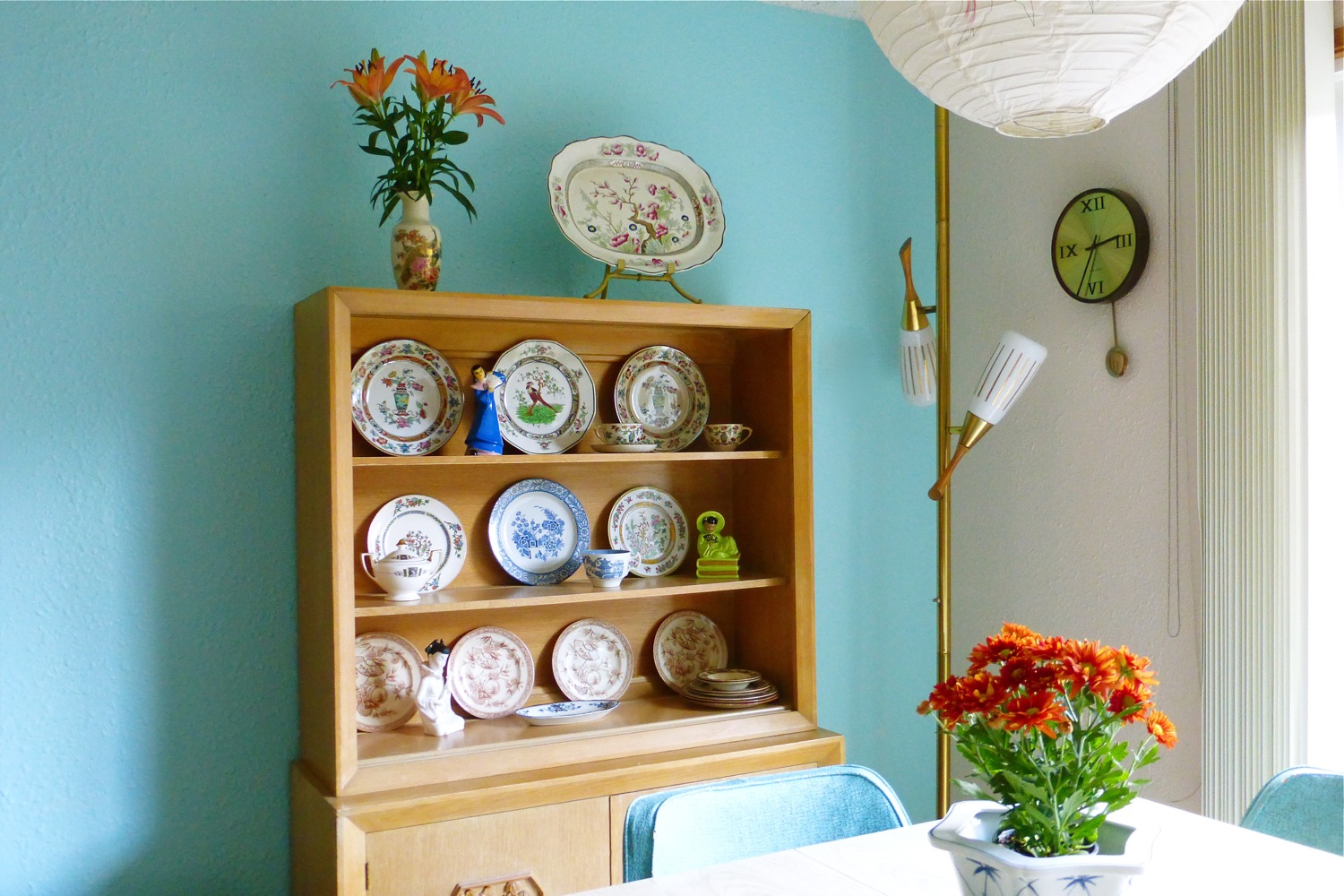
Well, as it turns out, that box of dishes started my obsession with antique Chinoiserie Revival (c. late 1800s - early 1900s) dish ware. Not only did I go back to the shop and buy them, but I have been on the hunt for more Chinoiserie-themed antique dishes ever since. I finally have enough pieces of this incredible English-made tableware to 'sort of' style my midcentury James Mont limed oak hutch and I'm excited to share the result thus far, with you dear reader, here today.
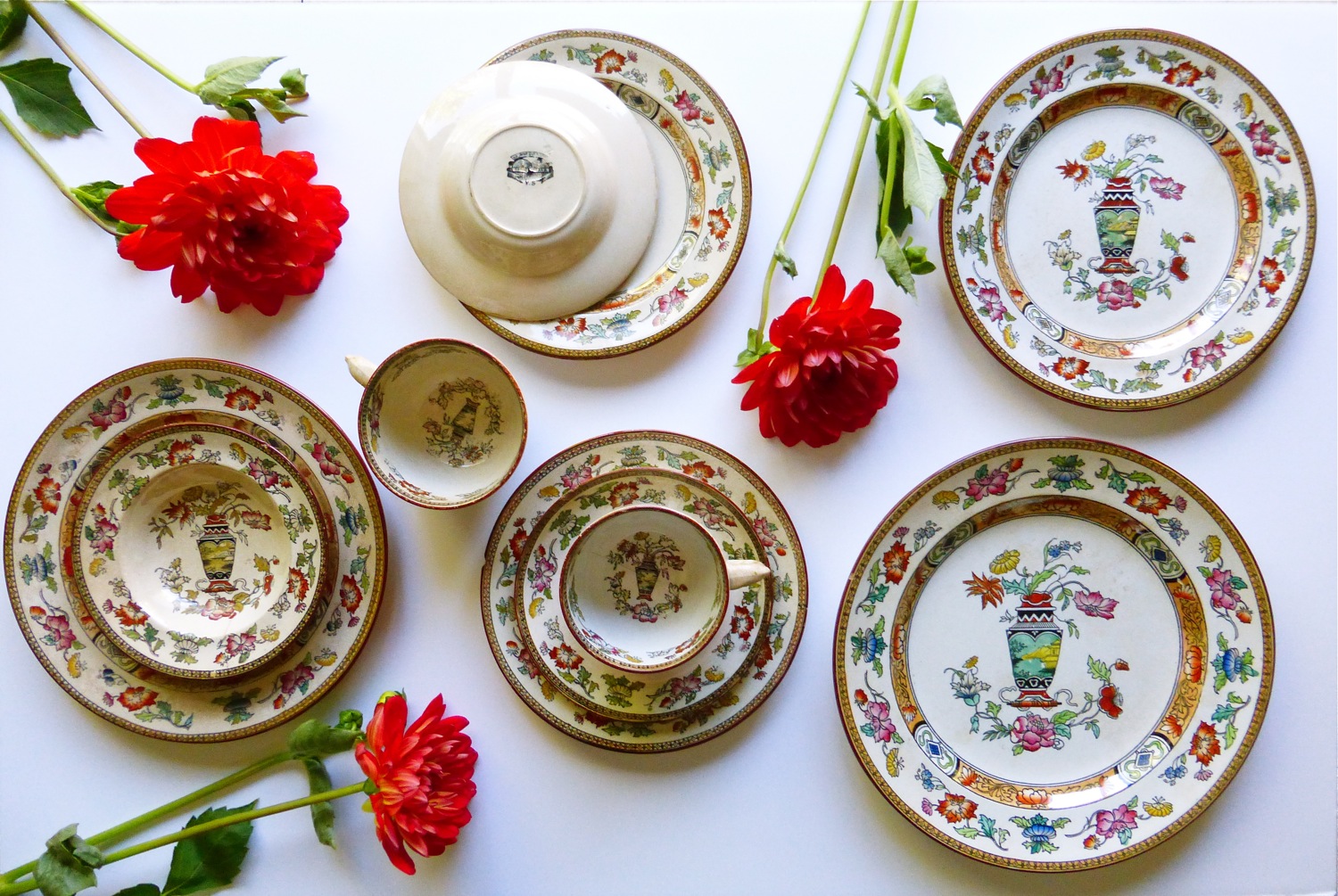
As mentioned above, the box of dishes that started this new passion of mine consisted of several pieces of late 1880s Brownfield & Son antique pottery with an unknown pattern name. Two of the dinner plates, two teacups and a saucer are on the top shelf of the hutch. The remainder of the dishes are on the bottom shelf to the right. And here is a photo of all of the items together:

If you are fond of the distinctive look of Chinoiserie, you might appreciate the whimsically styled decorative urns, the vibrant chrysanthemum outer borders and the highly detailed inner borders that make up this pattern. If so, more details about this Brownfield pottery can be found in the popular blog post Vintage Finds: Antique Brownfield & Son Chinoiserie Revival Pottery.
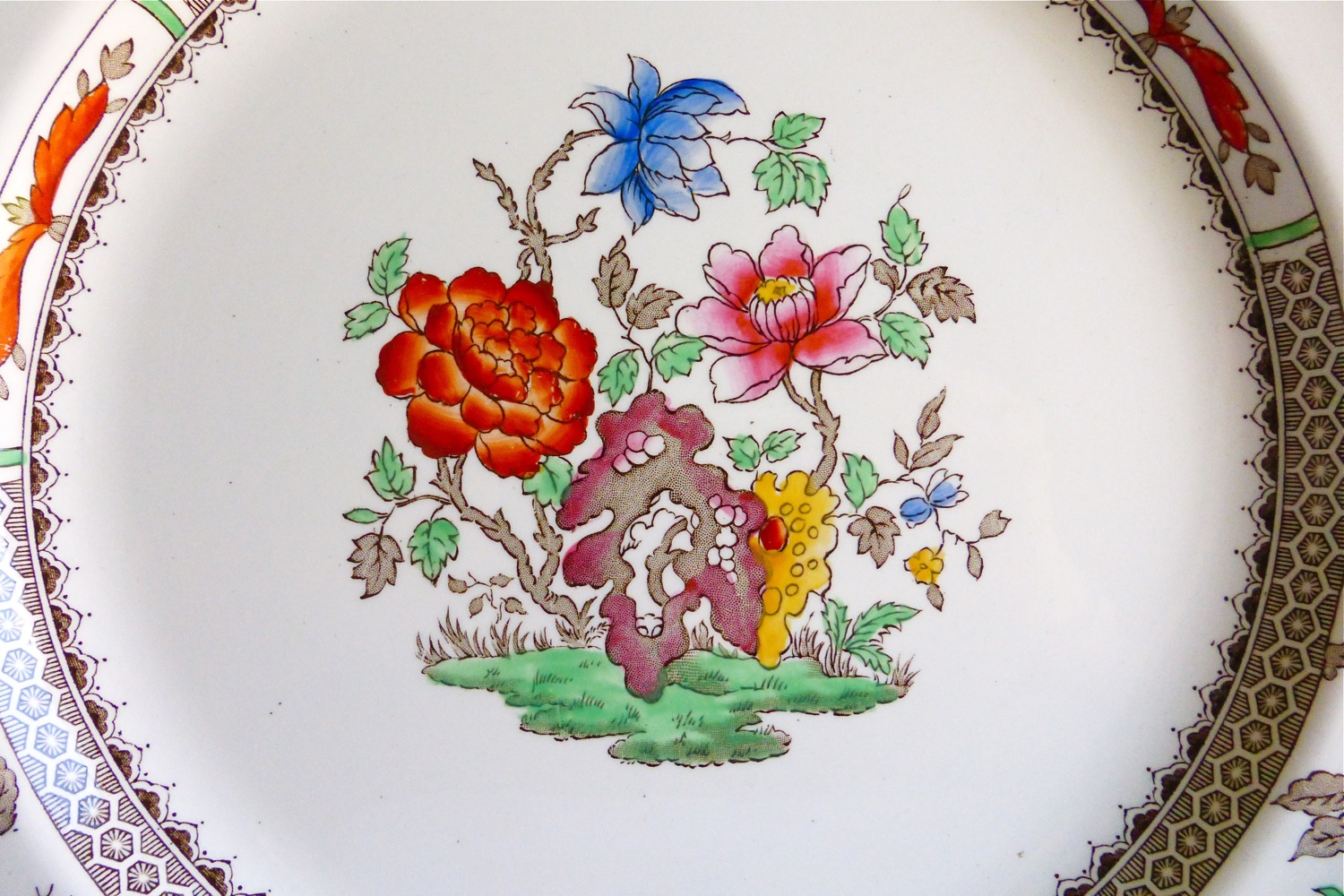
Also on the top shelf of my hutch, between the two Brownfield plates is this Royal Doulton 9-3/4" plate (c. 1902-22, 1927-36) featuring a formidable bird of prey in a pattern called Pekin:
Note how similar the style and colors of the chrysanthemum flowers and the inside border on this plate are to the Brownfield pottery and the repetition of a stylized image in the center.
Directly below the Pekin plate, on the middle shelf of my hutch, are two pieces by Wood & Sons from their Woods Ware collection - a 9" plate in the Wincanton pattern, and a teacup in the Canton pattern, both produced around 1917:
Perhaps there has never been any chinaware more timeless or classic than those decorated in various traditional blue and white patterns. The pattern known as Blue Willow is probably the most popular and well known of all. And there are likely hundreds if not thousands of variations on the theme. For instance, while the Canton teacup explicitly bears a version of the quintessential Blue Willow pattern, the Wincanton plate is quieter in its approach to Blue Willow with its abstract representation of it.
Another c. 1917 Wood & Sons Woods Ware piece in my hutch is a small oval platter on the bottom shelf:

Here we have another strong bird character at the center of attention. At 9 inches wide and 5 inches tall the platter has a different look and feel compared to the Wincanton plate and the Canton teacup. The pattern is called Mayfair and although blue and white is still the predominate color scheme, there is a bit of dark red, yellow and green added to the peonies and to the bird (peacock?). Overall, the glaze is laid on thicker and the top rim, where the dark red pigment has been added, has a bumpy texture.
Oh, and just in case anyone is interested, the figurines you see in my hutch are all 'midcentury' pieces that I feel support the Chinoiserie style and theme. Of course there was yet another asian or oriental themed trend in the 1950s, but that's another story for another time! The figurine shown with my Mayfair platter is a Kleine ©49.
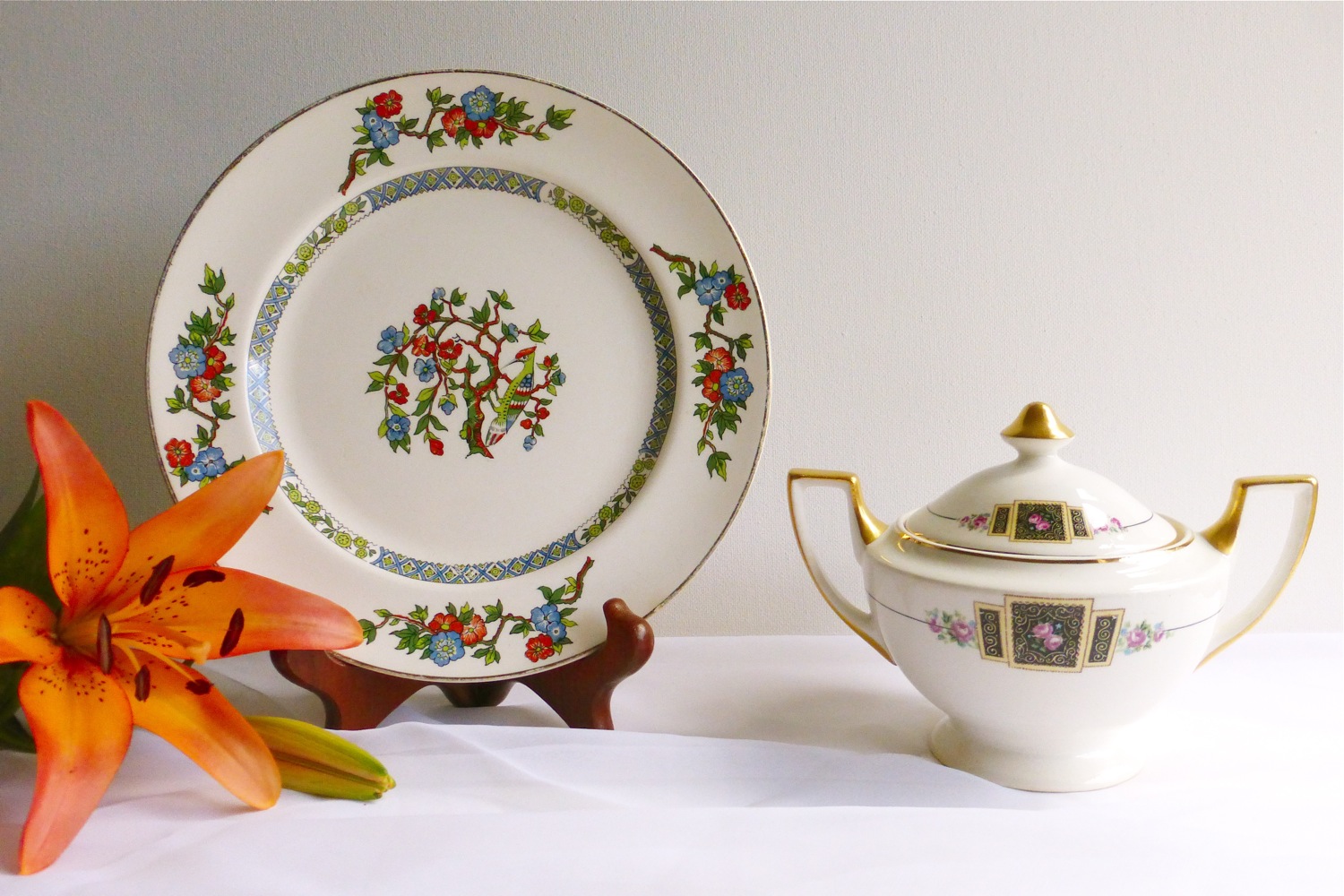
Going back up to the middle shelf of my hutch to the left is a circa 1913 Johnson Bros Pareekware 8" plate and a Cleveland China sugar bowl from about 1920:
Have you found the bird in the tree on the plate yet? I'm thinking it's a woodpecker. What do you think? Again we have a similar theme and style to the Brownfield & Son dishes and the Royal Doulton plate, with the colorful floral border, interesting patterned inner border and of course the stylized image in the center.
The Cleveland China sugar bowl is actually an Art Deco piece. I'm very fond of the shape of the bowl and I especially like the handles. Although its design influences are the Neo-Byzantine Revival and Greco-Roman movements from approximately 1890 through the 1920s I feel it also fits the aesthetic of the Chinoiserie style.
Also on the middle shelf of my hutch, on the far right, is a c. 1905 Foley Art China Peacock Pottery 8" plate in another quintessentially classic pattern called Indian Tree:
Like Blue Willow, Indian Tree has stood the test of time and you'll see many different manufacturers having made a variation of the pattern.
Are you starting to see why I am so jazzed about Chinoiserie Revival design? In just the few pieces I've managed to collect thus far, the repetition of style, like strings on a guitar or keys on a piano, is endless. The formality of the border treatments, coupled with the free-form, energetic center designs are like a piece of music that starts in a major key then suddenly changes to a minor key, surprising the listener, yet not sounding out of place. Amidst the rhythmic and ordered events of everyday life and the chaos of unexpected occurrences we are transported to another world of the designer's own making - a dynamic use of yin and yang principles in which harmony is the end result.
The midcentury figurine of the girl holding a fan next to the Foley Art China plate is one half of a bookend set, made in Japan. And yes, I searched the charity shop shelves high and low for the other half - presumably a boy, but did not find it. And it wasn't until I got it home that I realized the head had been glued back on. But that didn't matter - it's midcentury, of asian or oriental design, and a classic 1950s color - chartreuse!
So now let's look at the four Alaska H & R 7-1/2" plates on the bottom shelf of my hutch:
Ok, I'm stumped on the identification here! I have found one reference stating the manufacturer could have been either Hall & Read or Hughes & Robinson. Both companies manufactured earthenware in the late 1880s, and apparently 'Alaska' is the pattern name.
This same reference implied that the Alaska Gold Rush had something to do with the manufacture of this dish ware. Indeed, there were two gold rushes in the state of Alaska between 1897 and 1904, but what the connection is between those events and earthenware plates named Alaska is a mystery. Perhaps more investigation is needed...
The figurine of an asian woman dressed in white and playing a small musical instrument (on the bottom shelf of my hutch with the Alaska plates) was made by the Ardalt Lenwile China company in Japan in about the 1950s. Again, she is one half of a pair and the only one I have. It doesn't bother me that the figurines I've collected thus far are not pairs and exact matches - I enjoy having an eclectic mix of styles and colors within a theme.
And last but not least, sitting on the very top of my hutch, is a large Burgess & Leigh Indian Tree serving platter, measuring 15-1/2" wide and 13" high.
This second example (c. 1862 - 1907) shows us another variation of the Indian Tree pattern which has a completely different color palette. Again we have the thematic repetition of an outer floral border, inner detailed border and a stylized image in the center. Shortly after I wrote the blog post about the box of Brownfield & Son dish ware, I wrote another, also quite popular, blog post about this Burgess & Leigh platter entitled Vintage Finds: Antique Burgess & Leigh Chinoiserie Revival Indian Tree Platter.
Well, if you've made it this far, (even if you've only scrolled through and looked at the photographs) I can't thank you enough! I enjoy both collecting and digging into the history of this dish ware and sharing it here with you, dear reader.
If you are interested in styling your own hutch and are wondering where to start, the best place to begin is with something you love. As you can see here, I stuck with one type of antique dish ware and built a collection around that one theme. You might have a piece handed down from a relative or something you just purchased. It could even be the dishes you use everyday. Gather together items that resonate with you and play around and see what you come up with. And most of all, have fun with it.
Oh, and if you would like to know more about the history of my hutch, you can read about it in the post Vintage Finds: c. 1950 James Mont Chinoiserie Limed Oak Hutch.
Thank you!
Monday, June 4, 2018
Vintage Finds: Copeland Spode Chinese Rose
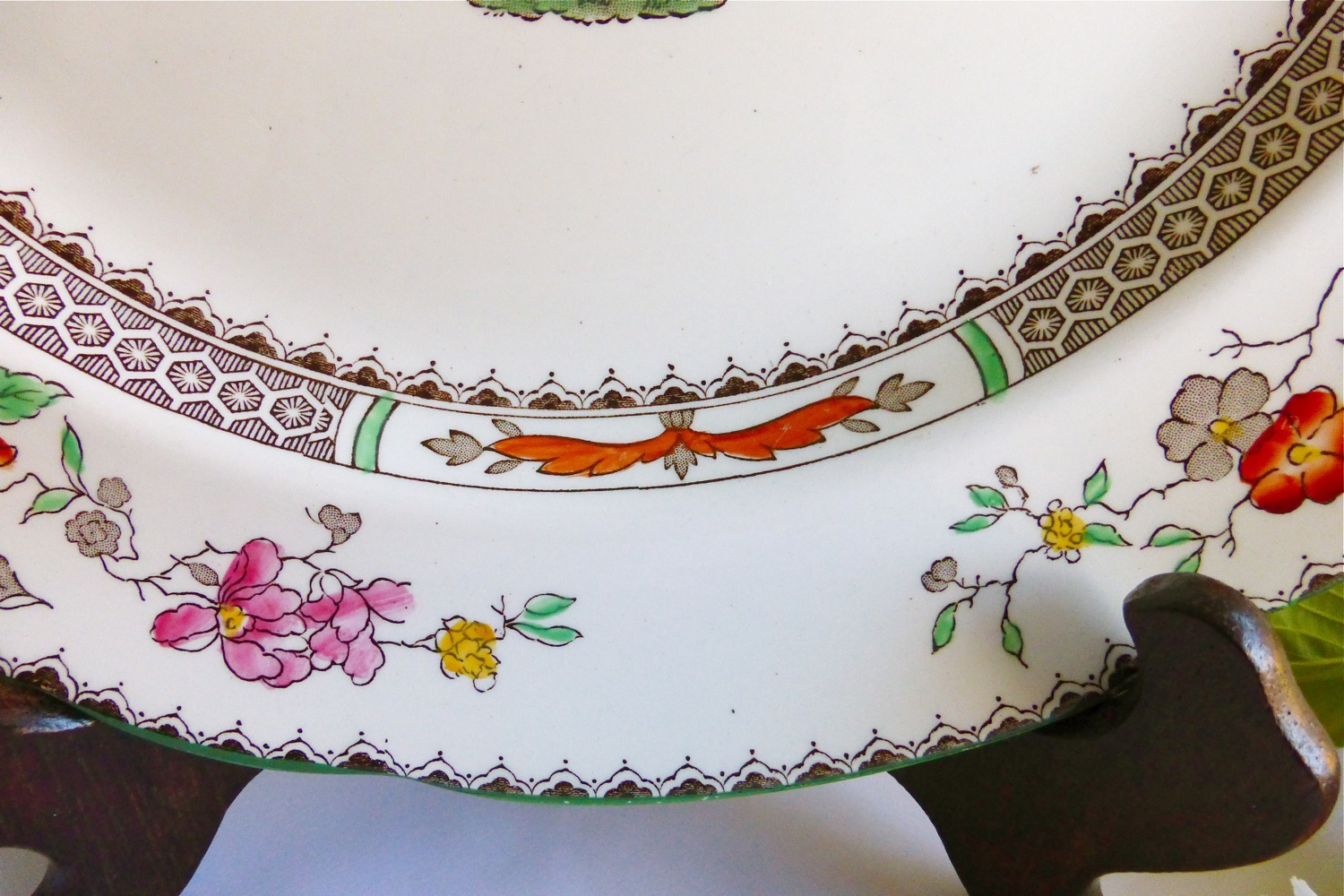
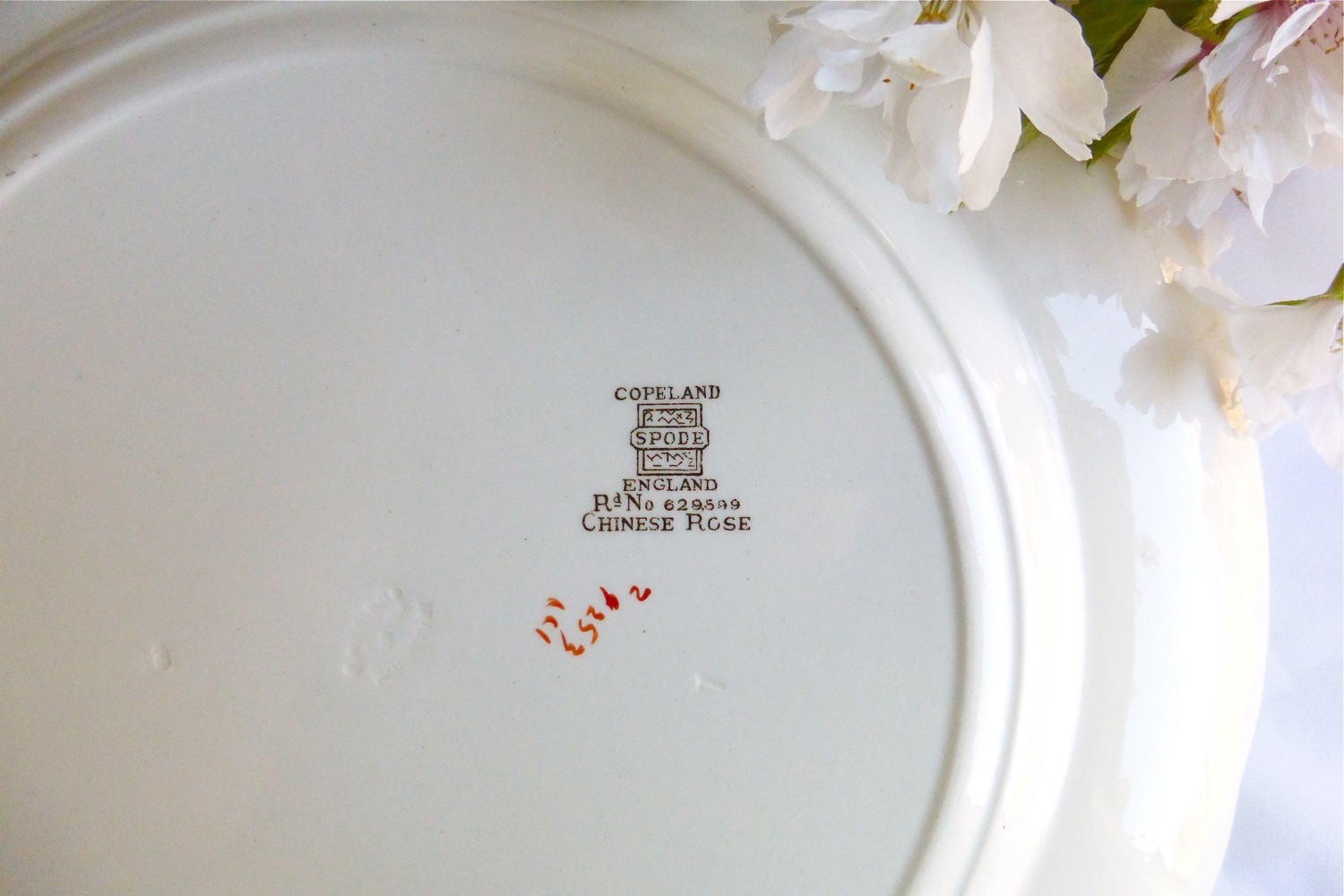
Hi friends! Have you ever tried to establish a manufacturing date for a piece of Copeland Spode china? I'm learning that it's a somewhat difficult task because not all of the pieces were marked, especially in the early years, which was around the 1700s. Granted I will probably never come across any Copeland Spode from that time period, but I did recently find this gorgeous Chinese Rose earthenware dinner plate with a 1931 back stamp.
Spode's Chinese Rose, with its quintessential Chinoiserie style, was an immensely popular china ware pattern with millions of pieces manufactured between 1911 and 2007. Its predecessor was a pattern called India - a blue and white ware 'Oriental' style pattern, designed in 1815. The inspiration for the India pattern came from Chinese porcelains produced during the K'ang Hsi period in China from 1700-1722.
Immediately upon seeing this one lonely antique plate, I knew that it was manufactured during the very Chinoiserie revival time period that I have become so very fond of.
From the delicate quality of the hand colored florals, to the highly detailed motif of the transferred pattern, there is a perfection of the Chinoiserie stylized design ideals that are faithfully captured in this example that I feel are equally true to the spirit of both the eastern and western traditions.
My favorite aspect of this plate is the center floral arrangement. Not only does it perfectly capture the essence of the Chinoiserie revival style in its theme, but each flower expresses its own dynamic energy and vitality as they actively engage with each other in their environment, and together they appear to be happily participating within this unique atmosphere.
As mentioned, the back stamp indicates, I believe, a 1931 manufacture date. The Chinese Rose pattern for bone china was registered with the British Patent Office on December 13, 1913 with number 629599 and manufactured in 1931 in earthenware, with pattern number 2/9253. Both of these manufacture numbers appear on the back of my plate and I know for sure that it is made from earthenware, so my best guess is 1931.
Later pieces of Chinese Rose (from about the 1970s on) had an updated newer back stamp and do not have the red hand painted numbers.
Thank you for letting me share one of my newest vintage finds. If you would like to see more Copeland Spode Chinese Rose, I made a Pinterest board which you can view here.
Saturday, May 12, 2018
World Collage Day
Hi Friends! Since Kolaj Magazine has declared today World Collage Day I thought it would be fun to share with you a few collage projects I'm currently working on.
Last month the local public library had its annual used book sale - tables and tables full of books for about $2.00 each. I happily filled one bag (the limit I imposed on myself!) with books about birds, flowers and art history. A couple of the books I purchased are shown above.
Birds are some of the most fascinating creatures on earth and the collage pieces I'm sharing with you here today are my creative expression regarding the importance of birds.
National Geographic Magazine has declared 2018 the Year of the Bird in celebration of the centennial of the Migratory Bird Treaty Act passed by the United States Congress in 1918. The purpose of the act is 'to protect birds from wanton killing.' According to the Geographic, "Things with feathers can be found in every corner of every ocean and in land habitats so bleak that they're habitats for nothing else." Their diversity, social structure, ability to fly and migrate hundreds or even thousands of miles surely commands our respect. Not surprisingly, the Geographic posits that bird populations indicate the health of the ethical values of humans. From the recognition that birds are living dinosaurs, having witnessed life on earth for millions of years, to the fact that they connect us to the natural world, we must care for and about birds simply because humans have the unique ability to reason and reason inevitably leads one to a place of responsibility.
Because of these facts and more it only seems right to give owls a regal place in my imaginary owl world - a place that respects their ability to survive in spite of the pressures of human intervention.
Thanks for letting me share.
Saturday, April 7, 2018
The Dawn of Helena's Liberation
Hello Friends! As I was combing through my file folders of images cut from magazines for the February One Little Word collage I came across a particular image that I have been meaning to use for quite some time. Knowing that the intake for a spring art show at a local gallery was coming up soon I decided to make an idea I had for using the image a priority and worked on making it happen.
The image I found in my stash, a two page spread from a National Geographic magazine, is now the background of the above piece. As I recall the caption in the Geographic stated that the photograph is of an abandoned house in a desert somewhere. Months ago, as I cut the image from the publication, I had this idea that someday I would like to create a scene within this intriguing magical space.
And what scene could be more intriguing or magical than the transformational moment when one receives specific knowledge of a coming event that will alter their life for the better in significant ways?
Meet Helena, whose name means bright shining light, and is the subject of the assemblage I'm sharing with you here today. I call this piece The Dawn of Helena's Liberation. Her real name is Young Girl from Anzio (Rome) and she is a Roman copy of an Hellenistic sculpture. Helena features prominently in this collage because she represents the women of the Hellenistic era (323 BC - 31 BC) who welcomed new laws that gave them legal, social, economic and cultural freedoms as well as educational opportunities, making them smarter, legally freer and economically stronger. This is my ode to that moment in time.
During the Hellenistic era, new philosophical schools of thought influenced the loosening of social constructs for women. For example, women were allowed to draw up and sign their own contracts and legal documents that protected their social status which made the exploitation of them more difficult. And a prominent improvement in women's lives was that they were no longer required to have an escort or chaperone in legal matters or to enter public spaces or gymnasiums.
Being able to leave their homes unescorted, women became integrated into society and in the workforce, albeit in their more traditional Greek roles such as weavers, pot makers, launders, grocers and barmaids.
With education, women became literate in subjects such as mathematics and literature and worked as philosophers, poets, writers, architects and musicians.
Young Girl at Anzio was excavated in 1878, having been found in an early Roman Imperial villa, and is thought to be a priestess. When I first saw her in my vintage Art of Classical Greece book several months ago, I knew she would be perfect for some as yet unknown collage project. Then, as I was flipping through the book again, looking for an image to cut out and place on the mound of sand in the Geographic magazine spread, I knew she would be perfect.
I thought, what better recipient of a life changing event than a priestess named Helena? And how about the spiritual significance of a luminous silver bird that symbolizes the coming of the new rights bestowed upon women and who intimately delivers that message? I felt that this noteworthy dramatic story of transformation is best told in the midst of an azure colored temple and that it only seemed right that an event of this magnitude should take place within a powerful golden 'other-world' atmosphere. There, Helena sat, ready, waiting, clock ticking away. And when the moment came, she stood and formally received a grand and historic moment.
Are there significant moments in the history of women that you are fond of? What stories of women's transformation do you enjoy? Leave me a comment or send me an email.
During the Hellenistic era, new philosophical schools of thought influenced the loosening of social constructs for women. For example, women were allowed to draw up and sign their own contracts and legal documents that protected their social status which made the exploitation of them more difficult. And a prominent improvement in women's lives was that they were no longer required to have an escort or chaperone in legal matters or to enter public spaces or gymnasiums.
Being able to leave their homes unescorted, women became integrated into society and in the workforce, albeit in their more traditional Greek roles such as weavers, pot makers, launders, grocers and barmaids.
With education, women became literate in subjects such as mathematics and literature and worked as philosophers, poets, writers, architects and musicians.
Young Girl at Anzio was excavated in 1878, having been found in an early Roman Imperial villa, and is thought to be a priestess. When I first saw her in my vintage Art of Classical Greece book several months ago, I knew she would be perfect for some as yet unknown collage project. Then, as I was flipping through the book again, looking for an image to cut out and place on the mound of sand in the Geographic magazine spread, I knew she would be perfect.
I thought, what better recipient of a life changing event than a priestess named Helena? And how about the spiritual significance of a luminous silver bird that symbolizes the coming of the new rights bestowed upon women and who intimately delivers that message? I felt that this noteworthy dramatic story of transformation is best told in the midst of an azure colored temple and that it only seemed right that an event of this magnitude should take place within a powerful golden 'other-world' atmosphere. There, Helena sat, ready, waiting, clock ticking away. And when the moment came, she stood and formally received a grand and historic moment.
Are there significant moments in the history of women that you are fond of? What stories of women's transformation do you enjoy? Leave me a comment or send me an email.
Wednesday, March 14, 2018
Little Yellow Couch Style Manifesto
Hi Friends! Do you listen to podcasts? I listen to several, and one of my favorites is Style Matters, hosted by Karen June Grant and Zandra Zuraw of the interiors blog Little Yellow Couch. When I first heard Zandra say "we believe that your style comes from knowing who you are" and that their mission on the podcast is to "get to the substance behind the style" I was immediately hooked.
On the weekly podcast Karen and Zandra interview designers and stylists to find out why style matters to them. And each week I am continually amazed by how much I learn about style as I listen to stories from people who are passionate about not just decorating their homes, but how their homes are a reflection of their personality, interests and lifestyle.
My own journey of home decorating and styling is a fairly recent one but my passion for collecting vintage home wares has been going strong for years. The truth is that my home has been more 'junk store chic' than purposefully collected and aesthetically decorated or styled. Life has been so busy with work and the raising of children that I just never had the energy, brain space or 'know-how' for anything more.
But life is different now, changing. My children are grown and I strongly feel that it's time to get serious about style and why it matters to me. I found a great place to start is Karen and Zandra's Style Manifesto, a discovery tool designed to identify how your personal values align with how your home looks and functions. It's rather scary to realize that the clutter in your home can be considered a reflection of the clutter in your head! But face it, I must...
Through a series of five essay questions, Karen and Zandra take you through an inspection tour, so to speak, of your home. I have always felt that being self analytical is one of the harder tasks in life, but what I have also discovered is that journaling is the key to working out issues. The first part of the writing exercises take you through identifying your values and where your personality shows up in your home. Then you will be asked to pinpoint the elements of your personality that are missing in your home and encouraged to brainstorm ideas that will bring those characteristics you would like to make visible into the foreground.
Once you have finished answering the questions the fun part is creating your own manifesto - an actionable plan for how you will achieve your newly found style goals! And since a manifesto is a public declaration, I'm sharing mine here with you:
On the weekly podcast Karen and Zandra interview designers and stylists to find out why style matters to them. And each week I am continually amazed by how much I learn about style as I listen to stories from people who are passionate about not just decorating their homes, but how their homes are a reflection of their personality, interests and lifestyle.
My own journey of home decorating and styling is a fairly recent one but my passion for collecting vintage home wares has been going strong for years. The truth is that my home has been more 'junk store chic' than purposefully collected and aesthetically decorated or styled. Life has been so busy with work and the raising of children that I just never had the energy, brain space or 'know-how' for anything more.
But life is different now, changing. My children are grown and I strongly feel that it's time to get serious about style and why it matters to me. I found a great place to start is Karen and Zandra's Style Manifesto, a discovery tool designed to identify how your personal values align with how your home looks and functions. It's rather scary to realize that the clutter in your home can be considered a reflection of the clutter in your head! But face it, I must...
Through a series of five essay questions, Karen and Zandra take you through an inspection tour, so to speak, of your home. I have always felt that being self analytical is one of the harder tasks in life, but what I have also discovered is that journaling is the key to working out issues. The first part of the writing exercises take you through identifying your values and where your personality shows up in your home. Then you will be asked to pinpoint the elements of your personality that are missing in your home and encouraged to brainstorm ideas that will bring those characteristics you would like to make visible into the foreground.
Once you have finished answering the questions the fun part is creating your own manifesto - an actionable plan for how you will achieve your newly found style goals! And since a manifesto is a public declaration, I'm sharing mine here with you:
And of course, I'm always in for a fun art project and the blank space at the top and bottom of the manifesto were just begging for a little bit of collage.
I hope you will consider listening to the Style Matters podcast and signing up to get your own Style Manifesto. I'm sure Karen and Zandra will be delighted if you did!
Thank you for letting me share.
Wednesday, February 28, 2018
Under The Plum Blossom Tree - An Etsy Affiliate
Hello Friends! A quick update for you. I'm excited to announce that Under The Plum Blossom Tree has been approved to be an Etsy Affiliate. What that means is that you will now see the official Etsy advertising banner on the sidebar or within certain posts in this blog. If you click on the link and make a purchase I may earn a commission.
To more fully understand what affiliate links are and how they work, please visit http://paidforadvertising.com/. Also, by law I am required to have a Disclosure Policy which is now posted at the top menu bar of this blog. You will also see my disclosure policy on any blog posts I may write that promote Etsy products.
Thank you for supporting Under The Plum Blossom Tree!
Subscribe to:
Posts (Atom)
©
Under The Plum Blossom Tree | All rights reserved.