Sunday, August 28, 2016

Camping At Newberry Caldera

Newberry Caldera, East Lake Newberry Caldera, Newberry National Volcanic Monument, volcanic lake

Volcanoes are both scary and fascinating. The thought of being near an exploding volcano is frightening, but as I stood on the floor of Newberry Caldera last week and thought about how this very large caldera was produced as a result of a volcanic eruption 75,000 years ago, my mind was blown away!

Newberry Caldera, in the Newberry National Volcanic Monument, is located on the eastern side of the Cascade Mountains in the Deschutes National Forest of Oregon and encompasses 54,822 acres. When Newberry Volcano exploded, the violent eruption produced two lakes - East Lake, pictured above, and Paulina Lake which is about one mile west of East Lake. Newberry Volcano is, to this day, an active volcano with both seismic and geothermal activity! 

Last week our family took great pleasure in escaping city life for a three day camping adventure in this captivating environment. For three days and two nights, we basked in warm sunshine and breathed clean dry air, surrounded by volcanic mountains, a variety of tall conifer trees, clear cool water and a fair amount of wildlife such as birds, mule deer, ground squirrels and chipmunks.

Cinder Hill Campground Newberry National Volcanic Monument, Cinder Hill Campground, Anderson campsite Newberry National Volcanic Monument
Newberry Caldera East Lake, Newberry National Volcanic Monument East Lake, Newberry East Lake
Newberry National Volcanic Monument
Golden Manteld Ground Squirrel Newberry National Volcanic Monument, Chipmunk Newberry National Volcanic Monument, Cinder Hill Campground Newberry National Volcanic Monument
Newberry National Volcanic Monument, camping at Newberry National Volcanic Monument, Cinder Hill Campground Newberry National Volcanic Monument
Map of Newberry National Volcanic Monument, Lakes of Newberry National Volcanic Monument, East Lake Newberry National Volcanic Monument, Paulina Lake Newberry National Volcanic Monument

Our campsite was situated amongst many pine trees and located near the shore of East Lake, in the Cinder Hill Campground. There's about one hundred yards between the camp and the lake, with willow bushes, tall grasses and sandy soil between the two. Of particular interest are the red, white, and black 'cinder bombs', or volcanic pumice rocks, that litter the floor of the caldera:

cinder bombs, volcanic pumice rocks, Newberry National Volcanic Monument volcanic pumice rocks

The campsite had ample room for our three tents and included a large picnic table where we set up the campstove. (That's Jim tending the stove.) There was also a fire pit which we used during the evenings for light, warmth and cooking. 

Newberry National Volcanic Monument Cinder Hill Campground, James Aoyama, James Aoyama at Cinder Hill Campground, James Aoyama at Newberry National Volcanic Monument
Cinder Hill Campground Newberry National Volcanic Monument, Coleman campstove, Coleman Powerhouse 413, campstove cooking

There were also some very simple meals:

camp breakfast, breakfast at Newberry National Volcanic Monument, Cinder Hill Campground camp breakfast, Joe's O's, Joe's O's breakfast cereal

On our one full day in this beautiful wonderland, relaxing and exploring were on the agenda. Audrey relaxed in the sun with a favorite book on the shore of East Lake and took occasional cooling dips in the calm water. Takeo explored the variety of interesting rocks that lay within the waters edge.

Audrey Anderson at Newberry National Volcanic Campground, Audrey Anderson at East Lake Newberry National Volcanic MonumentTakeo Anderson at Newberry National Volcanic Monument, Takeo Anderson at East Lake Newberry National Volcanic Monument

A hike was also a priority and Takeo, Jim and I did just that. We headed straight up the hill from the lake and found an animal trail to follow. We saw ancient volcanic rock formations, skeletal-like dead pine trees, and many new pine trees bursting with cones.

Newberry National Volcanic Monument, East Lake of Newberry National Volcanic Monument, snag at Newverry National Volcanic Monument, pine trees and rocks at Newberry National Volcanic Monument
Newberry National Volcanic Monument, pine cones at Newberry National Volcanic Monument, East Lake forest at Newberry National Volcanic Monument
Newberry National Volcanic Monument, pine cones at Newberry National Volcanic Monument, pine forest at Newberry National Volcanic Monument

It was a great pleasure to be able to sit quietly on the mountainside, soak up the magnificent view, and breathe in the fresh pine scent. To listen, watch, and observe. As I sat watching a flock of Clark's Nutcrackers flitting in and out of a snag (dead tree), communicating through call and response, I thought to myself: these are the moments to live for. 

June Anderson at East Lake of Newberry National Volcanic Monument, June Anderson photographer, June Anderson at Newberry National Volcanic Monument

As is characteristic of all of the National Parks we've visited here in the Western United States, one of Newberry Volcanic Monument's primary missions is its focus on recreation, and that is exactly why our family made the trip. Of course we all understand recreation to mean something we do for fun and is not work. But recreation also refers to a mental or spiritual consolation, or a source of comfort. On each of the two nights we camped, I lay in our tent, looking out its screened window at the silhouette of the trees against the sky at dusk, listening to the quiet stillness of the forest as the last of the evening light faded into darkness. That view and the tranquility of that moment came home with me and still resides in my mind's eye.

"Keep close to Nature's heart. Break clear away, once in awhile, and climb a mountain or spend a week in the woods. Wash your spirit clean."
-John Muir
SHARE:

Saturday, August 27, 2016

#collectandstyle - August Monthly Favorite

 @atelier_cocon_m Instagram favorite, collage, floral wreath, papier collie, collage with dried flowers, dried flower collage, shabby chic collage, shabby chic dried flower arrangement, shabby chic dried roses, shabby chic dried hydrangea, floral craft, crafting with dried flowers, vintage floral paper craft, vintage floral collage, vintage paper collage

Hello #collectandstyle community! Thank you for visiting the Under The Plum Blossom Tree blog. I'm so happy you are here!

Welcome back to another edition of #collectandstyle Monthly Favorite, where at the end of each month, one image from the Instagram hashtag #collectandstyle is featured here on the blog.

Have you had the pleasure of viewing Mayumi Ichiryu's Instagram gallery @atelier_cocon_m? Mayumi is a craft designer who possesses boundless energetic ideas for composition, using a wide variety of antique and vintage items.

Mayumi's use of well-worn backgrounds, coupled with an amazing collection of interesting objects and dried flowers that she crafts into pretty wreaths, contribute to a very unique take on the shabby chic style. As well, her strong pastel color palette provides beautiful harmony and stability to her Instagram feed.

I love the art form of collage, and really enjoy how Mayumi utilized it in the image above, with her creative use of dried hydrangea petals as a 'dress' for her 1950s inspired piece.

Besides creating beautiful images for her own Instagram gallery, Mayumi is also a moderator on Instagram for @tv_retro and @antique_r_us, as well as being a member of #9vaga_members99. You can also find her on her own website, ameblo.jp/haidosora.

Thank you for stopping in! If you would like to participate in #collectandstyle, click here for the details. I hope to see you there soon!
SHARE:

Monday, August 8, 2016

Vintage Finds: Antique Brownfield & Son Chinoiserie Revival Pottery

Brownfield & Son, Brownfield & Son dishes

On a recent weekday trip to my favorite downtown charity store, the Assistance League Thrift Shop, I discovered a small box of dishes tucked away on a shelf in the back of the shop. A sign on the box said "Brownfield and Son dishes, pattern number 8909, introduced 1879. Dishes are as found. Use for crafts? Priced as a set, $5.00." I suppose someone who knew anything about antiques would have scooped up the box and happily paid the five dollars.

Not me.

Although I've become quite familiar with the 'vintage scene', and comfortable in my knowledge and expertise in buying pieces that I'm attracted to, I know next to nothing about antiques, so I passed up on the purchase. 

But that evening I found myself thinking about those Brownfield dishes, recalling the pattern, the colors, and the crazing on the glaze. What was especially interesting was the very wide range of wear and use amongst the pieces, from chipped, cracked and color-worn, to almost perfectly preserved, and all had a gorgeous aged patina. Clearly these varying levels of wear show how the items were individually used and cared for during their lifetime over the past century and a half. From a favorite teacup used each and every morning for many years, to the one dinner plate that sat reserved for a special guest, just imagine the stories that each piece could tell!  

As well, I realized that the pattern, with its graceful chrysanthemum-like flowers and the interestingly shaped urn with a depiction of a tiny Asian style building with mountains and a tree in the background, were in fact, the very Chinoiserie style I have recently come to love.

So, when Saturday morning came around, I went back to the shop to see if the box of antique dishes was still there, and if so, that I would buy them. And I did.

Brownfield & Son, W. Brownfield & Son, W. Brownfield & Sons, Chinoiserie pottery, Brownfield & Son Trademark VS, Brownfield & Son 4773, Brownfield & Son 8909, Brownfield & Son 8908, Cobridge Works, Cobridge Factory, Cobridge on Waterloo, Cobridge 1808

Although the Chinoiserie style was fashionable worldwide during the 17th and early 18th centuries, it fell out of favor by the 1760s. Then in the mid-nineteenth century there was a renewed interest in Asian themed decor, and it has continued in popularity into the modern era.

My 'new' old box of dishes were made during the 19th century revival period of the Chinoiserie style. A few of the pieces are back stamped 'Brownfield & Son, No. 115', and I've been able to confirm that this particular back stamp was used between 1871 and 1891. Each of the pieces has the number '4773' hand painted in red, as well as 'Brownfield' and dates of manufacture impressed into the clay. These dates are 1878, 1879, and 1880.

Brownfield & Son, W. Brownfield & Son, W. Brownfield & Sons, Chinoiserie pottery, Brownfield & Son Trademark VS, Brownfield & Son 4773, Brownfield & Son 8909, Brownfield & Son 8908, Cobridge Works, Cobridge Factory, Cobridge on Waterloo, Cobridge 1808

Curious to know the history behind these lovely dishes, I did some research, and here's what I found:

According to an 1886 advertising pamphlet, William Brownfield & Son were successful manufacturers of  'Useful and Ornamental Goods in China, Earthenware, Stoneware, Majolica, and Parian'. From about 1850 until 1891, their Cobridge Works factory, at Stoke-on-Trent, England, made these house wares, and employed about 500 men, women, and children.

William Brownfield (1812-73), the son of an earthenware potter, began his own career in earthenware manufacturing at the Cobridge Works pottery factory, which was built in 1808 and located on Waterloo Road. The factory was occupied by a succession of producers over the years, including Brownfield, until November of 1850 when Brownfield started working on his own there, producing his signature earthenwares, blue-printed and iron-stone ware, hand-painted wares, and one of the firm's specialties: moulded stoneware and Parian jugs. In 1871 the business became a partnership, when Brownfield's eldest son, William Etches Brownfield, joined his father. Porcelains were introduced that same year. In 1876 another of Brownfield's sons joined the business. W. Brownfield and Son(s), as it became known, grew into a successful large home and export trade business, with about 600 employees, into the 1880s.

In 1893 Brownfield's Guild Pottery Society Ltd. was formed to carry on the work of William Brownfield, until 1900 when the Cobridge Works was closed down and demolished. The Myott brothers rebuilt on the site in 1901, establishing yet another pottery factory - but that's another story in the great tradition and historical timeline of pottery manufacturing in the United Kingdom!

As mentioned, I've become very fond of the Chinoiserie style and a recent purchase of a c.1950 James Mont Chinoiserie Limed Oak Hutch brought the historic aspects of Asian themed house wares into focus for me. Since then I've been actively researching it, as well as going through my vintage collections looking for similar items with which to style my hutch.

I'm very pleased with the purchase of these historic pieces of Brownfield and Son pottery. These new old dishes will certainly enhance the variety of Chinoiserie style items in my collection, and I look forward to adding my story to such beautiful old relics.

  
SHARE:

Sunday, July 31, 2016

#collectandstyle - July Monthly Favorite

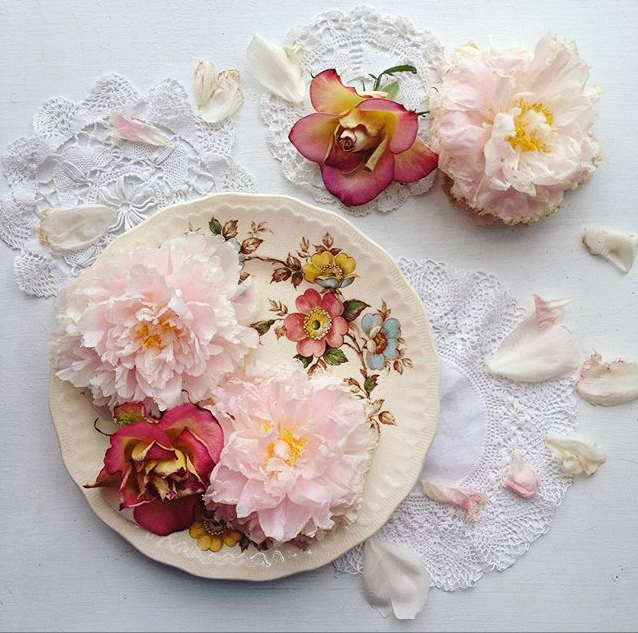
bymeeni, Madeline Norris, bymeeni on Instagram, #collectandstyle Instagram hashtag, floral plate and flowers

Hello #collectandstyle community, thank you for visiting the Under The Plum Blossom Tree blog! It is a joy and a pleasure to share with you my favorite image from this month's Instagram #collectandstyle hashtag. Please welcome the multi-talented artist Madeline Norris, who is known on Instagram as bymeeni

In her own words, Madeline is a "mama, artist, maker, lover, dancer, sister, dreamer, friend, singer, and daughter". If you were to view her blog or any of her various social media links, Madeline's talents and interests reach far and wide. Well versed in both art and craft, you'll find her skillfully drawing original animal and people characters, wielding a craft knife and creating magnificent paper cuttings featuring birds, hearts and flowers, hand sewing beautifully dressed cat, bunny and fox dolls, and teaching children how to paper craft windsocks and carnival headdresses.

Madeline is also a baker, who often uses seasonal ingredients. Some of the delicious looking recipes she has recently made and shared are her lavender biscuits with lemon glaze, rose petal chocolates, meringues with cream and fresh berries, and a raspberry and red currant cordial.

Nature plays a large role in Madeline's life; she enjoys gardening, walking, and photographing the outdoors. You'll find yourself appreciating the many flowers, trees and beautiful skies that she lovingly captures with her camera. She runs a seasonal hashtag on Instagram, the current one being #summercolourloving, so be sure to share your summertime nature-inspired images with her there.

Social activism is important to Madeline. She recently contributed her quilting, fiddle playing and singing talents to a local effort to assist refugees, and is involved in building relationships of trust in her neighborhood through #nearneighbours on Instagram.

As you can see, Madeline possesses an abundance of talent and that may have you wondering, of all these gifts, what draws me most to Madeline's work? 

That is very easy for me to answer! The above still life image is a small sampling of her vintage crockery collection, styled beautifully with pretty doilies and seasonal flowers. Madeline is a regular contributor to #collectandstyle, and I enjoy seeing how she styles beautiful old ceramics, whether it's with freshly picked flowers, or her favorite recipes.

Want to find out more? You can find Madeline on Instagram, or at her blog, meeni.co.uk. You can also find her on TwitterFacebook, Pinterest, and YouTube, so be sure to follow her!

Thank you for stopping in; I hope you've enjoyed getting to know the creative personalities behind each of the monthly #collectandstyle images I've featured so far, and I look forward to seeing all of your delightful postings there over the next month. 

If you would like to participate in #collectandstyle, you can get all the details here. I'll see you there soon!


SHARE:

Saturday, July 23, 2016

Vintage Finds: Tickled Pink!

Daher Decorated Ware, Designed by Daher, Daher of England, Daher made in England, Daher Long Island New York, Daher 11101, Old Royal Bone China England, Old Royal Bone China Teacup and Saucer, Vintage Teacup and Saucer, Old Royal Vintage Bone China Teacup and Saucer, English Bone China, Chinoiserie style lamp, vintage Chinoiserie style lamp, Oriental vintage lamp, Oriental girl in dress vintage lamp, Asian girl wearing dress vintage lamp

Hi Everyone! Today, I'm delighted to share with you a sampling of color filled vintage finds from a few of my recent treasure hunting adventures. It's exciting to find the sorts of home wares that I adore, and I also love the challenge of styling and photographing those items for you, both here and @undertheplumblossomtree on Instagram. 

In deciding what to share this month, I realized that the three objects shown in the picture each had the color pink in common, and that I was captivated by how well they harmonized. 

The blush pink Old Royal bone china teacup and saucer is a calm and stable element, compared with the more lively shades of pink in the Oriental dancing girl ceramic lamp base, and the vigorous saturated pinks in the stylized flowers of the Daher of England decorated tray.

Very soon, I plan on fitting hardware and a cute shade on this old ceramic base, and placing my new 'Chinoiserie' styled lamp on the bedside stand. And on a lazy morning in the not too distant future, there will be tea served in bed - in the pink Old Royal bone china cup, carried in on the Daher tray. What fun!

Do you enjoy styling, and using, your vintage finds? If so, please join me on Instagram at #collectandstyle. There are now over 1,000 images posted to the #collectandstyle gallery, and you can meet other like-minded creatives and have some fun. See you there!
SHARE:

Saturday, June 25, 2016

#collectandstyle - June Monthly Favorite

@gingerfancy on Instagram, collect and style, collect style, vintage collection, World War II memorabilia

Hello #collectandstyle community, I'm so happy you're here, at the Under The Plum Blossom Tree blog! Today, I'm excited to be featuring my favorite image from this month's Instagram #collectandstyle hashtag. Meet gingerfancy, who is, in her own words, "a Minnesotan discovering wonder and magic in the everyday". 

Barbara Marincel's Instagram gallery is full of beautiful flowers and vintage findings, but what really tugs at my heart most in Barbara's images is the way she lovingly styles her collection of precious family photographs and mementos, such as the above tribute to her father. She has also featured letters from long ago written by family members, a diary kept by her grandmother, and her uncle's war rations book, all of which she lovingly shares, along with other tidbits of her family history.    

Barbara's father, Leonard Henry Resch, served in the United States Army and fought in several battles, including what is considered to be one of the most famous battles in history, the allied forces' landing in Normandy on D-Day, June 6th, 1944.

In the caption to the above photo in her Instagram gallery, Barbara stated: "My dad was in the third assault wave to hit Omaha Beach... that morning. His unit took 50% casualties. He always told me that courage is being scared but doing the right thing anyway. He would know."

In addition to her own beautiful gallery, Barbara is also a member of several Instagram hubs and is a moderator for illustrious_art. In addition to her work on Instagram, Barbara also blogs at discoveriesofgrace.wordpress.com, where you'll find "Everyday Wonders and Gingerfancy Photography." There, Barbara writes about living life to the fullest despite chronic illness, and is in the planning stages of starting up her own fine art photography business. 

Thank you Barbara for sharing your beautiful photos to the #collectandstyle gallery!

If you are a collector and would like to participate in my Instagram hashtag project, you might like to read #collectandstyle - A New Instagram Hashtag. See you there!

SHARE:

Sunday, June 19, 2016

Styling The Seasons - June

circa 1950 James Mont Chinoiserie Limed Oak Hutch, Numi Organic Tea, made in Japan, ceramic birds made in Japan, wild sweet peas, Homer Laughlin, Homer Laughlin Virginia Rose, Homer Laughlin Virginia Rose Moss Rose, Homer Laughlin Fiestaware, Homer Laughlin Persimmon Fiestaware

The urge to preserve our memories is a basic human phenomena, which has endured over time, and the methods we use to record the events of our lives are steeped in traditions such as writing and photography. These days, we might even prefer writing on paper or perhaps taking photos with our film cameras, to the more modern electronic devices available to record our thoughts, hopes, dreams or remembrances. 

But even in this modern age we may still want to find more traditional ways to express the significance of some of life's more memorable moments. And in our homes and other personal spaces, we might gather together objects and memorabilia, and display them in a way that, hopefully, communicates the special meaning of those special times.

Thus, my Styling The Seasons post for the month of June represents two significant and memorable events that happened within the last month - my first foray into sponsored posts on Instagram, with Numi Organic Tea, who sponsored my #collectandstyle hashtag on Instagram for the month of May, and the purchase of a circa 1950 James Mont Chinoiserie Limed Oak Hutch.

circa 1950 James Mont Chinoiserie Limed Oak Hutch

Several of the tea related objects on the shelves of this newly acquired hutch are the result of my collection habit going into full gear, for the sake of tea. If you've been on Instagram lately you may be aware of a recent styling trend using flowers and tea or coffee as design elements. I was drawn towards this, both because I loved the idea of a good scrummage through a charity shop searching out vintage tea cups and saucers, and I also enjoy the challenge of having new subjects to style and photograph. As well, the tea and coffee trend fits nicely with my #collectandstyle hashtag.

I thrifted all of the teacups and saucers, as well as the neutral colored hand painted Japanese teapot on the middle shelf (right side) and the creamer next to it. The white Chinese teapot, also hand painted, (top shelf right), has been in James' family for a very long time, since the early 1950s. The dinner plate on the top shelf, also thrifted, was made by the Homer Laughlin China Company in 1940. 

The bamboo box on the bottom shelf is very special to me because it was a gift from Numi Organic Tea. The grand prize during their May sponsorship was their "Flowering Tea Set in Bamboo" gift box. They sent me one of the gift sets for styling and sampling, and I plan on reusing the beautiful hand crafted bamboo box for memorabilia. 

All four of the ceramic birds are some of my most precious keepsakes - they are all from my childhood. I really have no idea how it is that I still have them! While growing up in the city of Chicago, there were many Saturdays when I would walk to the neighborhood shopping district with my weekly allowance. One of my favorite stores there was Woolworth's, and that is where I bought all of these colorful, made in Japan birds, one at a time.

No Styling The Seasons post would be complete without flowers, and I am happy to share a bouquet I made with wild perennial sweet peas. For years I've been seeing the many lovely wild pea vines growing next to the bike path along the Willamette River, and recently thought it would be fun to grab my clippers, gather some up, and bring them home.

circa 1950 James Mont Chinoiserie Limed Oak Hutch, wild sweet peas, vintage Japanese wooden lamp
circa 1950 James Mont Chinoiserie Limed Oak Hutch, wild sweet peas, wild sweet peas in vintage Asian designed container

Such a bright color! But what do you think, is this magenta or fuchsia? What I really love about this color is the subtle underlying blue or blue/violet tone, and as they fade, these wild pea flowers gradually become that darker bluish shade.

I began this wild floral arrangement by placing a frog on the bottom of a vintage ceramic container. Luckily, I happened to have the right size and shape frog in my collection of flower arranging tools:

Flower arranging using a frog, how to use a frog to arrange flowers, wild sweet pea flower arrangement using a frog

I gathered the flowers in pairs back to back, and placed the pairs first in each corner of the vessel, then began filling in the front, sides and back in the same manner, poking the stems securely down onto the prongs of the frog. I repeated with double stems along the front, then directly behind this row of flower pairs, I placed single stems, all facing front using longer stems, in order to build some height in the middle of the arrangement.

wild sweet peas, wild sweet peas in Asian style container, wild sweet pea flower arrangement, Asian style flower arrangement, Asian style flower arranging

This vintage container, with its Asian influenced design on the front and repeated on the back, has a base style that echoes the 'feet' on the James Mont Chinoiserie hutch. Have a look:

circa 1950 James Mont Chinoiserie Limed Oak Hutch, vintage hutch, vintage Asian style hutch, Asian appliques on vintage hutch

It's interesting how the design of the cabinet base, with its cut-away groove between the cabinet and the pedestal, creates the illusion of the base floating on its pedestal legs. 

As long as we are focusing on the bottom portion of this hutch, check out the lovely three dimensional appliques on the doors!

circa 1950 James Mont Chinoiserie Limed Oak Hutch, appliques on circa 1950 James Mont Chinoiserie Limed Oak Hutch, close up view of appliques on circa 1950 James Mont Chinoiserie Limed Oak Hutch

This pair of elements is what places this piece of furniture squarely into the 'Chinoiserie' genre; with its evocation of a Chinese garden scene, it is very reminiscent of the famed 'Blue Willow' dishware pattern. As well, the uncomplicated design of the piece as a whole also lends itself to an Asian influenced style.

Owning a hutch has been on my wish list for years - I always wanted a special place to gather and show my favorite vintage pieces. And it may surprise you to know that I didn't want just any hutch, but this exact one! Some years ago, I had seen a limed oak James Mont hutch in a furniture magazine from the early 1950s, and always dreamed of owning one exactly like it.

And now that this wonderful vintage hutch is here in the dining area of my kitchen, I'm looking forward to the promise of future styling opportunities, displaying all of the fun collectables and family mementos that it will hold on its shelves, and in my heart, for years to come. 

circa 1950 James Mont Chinoiserie Limed Oak Hutch, vintage oak hutch,

If you would like to read the story about my purchase of this hutch, you can find it here: Vintage Finds: c. 1950 James Mont Chinoiserie Limed Oak Hutch. Also, if you would like to know more about my Instagram hashtag #collectandstyle and find out how you can participate, you may like to read #collectandstyle - A New Instagram Hashtag

And finally, Styling The Seasons is the brainchild of Katy Orme at Apartment Apothecary and Charlotte at Lots and Lotts. You can participate by styling a surface in your home that reflects what the month means to you and sharing it on your blog and/or on social media using the hashtage #stylingtheseasons.

hydrangea, blue hydrangea

Thank you for reading!


SHARE:
© Under The Plum Blossom Tree | All rights reserved.
Blogger Template Created by pipdig